July-Aug 2026 On the Same Page Selection
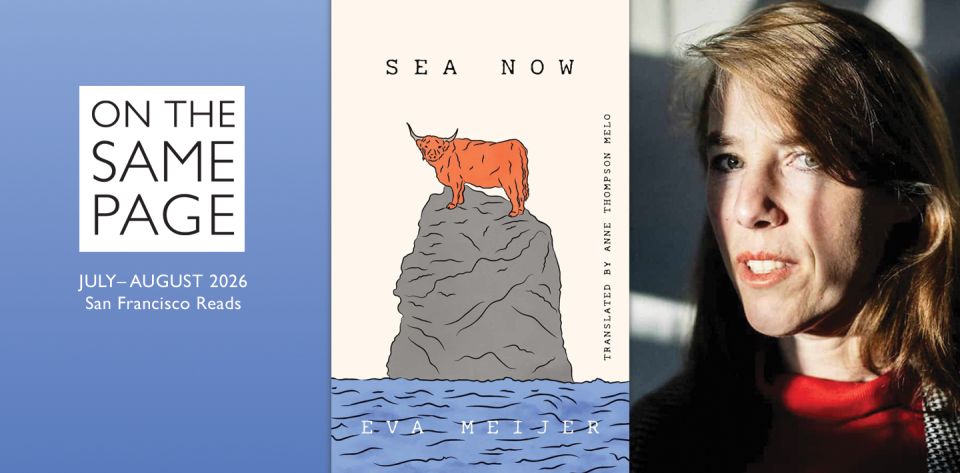
Sea Now by Eva Meijer, translated into English by Anne Thompson Melo, is a haunting climate fiction novel set in a drowned Netherlands, where rising seas have erased cities and forced people inland. Amid this chaos, three women set out in a small boat to search for loved ones, navigating a world reclaimed by seabirds, whales and kelp forests. Blending philosophy and nature writing, Meijer explores resilience, loss and what it means to listen when the sea speaks.
Sea Now was selected as part of Everybody’s climate.
Eva Meijer is a Dutch philosopher, visual artist, writer and singer-songwriter. Her fiction and nonfiction works have been translated into over twenty languages. Since the publication of her first novel in 2011, her works have received numerous awards, including the Halewijnprijs honoring her oeuvre. Her books have been met enthusiastically by both local Dutch and international press, including reviews in The Guardian, Der Spiegel and The New York Review of Books.
Anne Thompson Melo is a Scottish-based translator who studied Dutch and German and spent many years translating brochures for a German car manufacturer. She was longlisted for the John Dryden Translation Prize in 2022 and shortlisted for the Goethe-Institut Award for New Translation in 2023. Winning the 2024 Peirene Stevns Translation Prize gave her the opportunity to work on her first literary translation.
Eva Meijer and Anne Thompson Melo will be in conversation with Gregory Hom at the Main Library on August 18 at 6 p.m.
Gregory Hom is the Program Manager of San Francisco Public Library’s Wallace Stegner Environmental Center, a role he has held since 2023. He has worked with SFPL since 2008, supporting environmental programming and community engagement.
This program is sponsored by Friends of the San Francisco Public Library.
What role does the sea play in the novel? Does it feel like a character, a force of nature, or something else?
How does the novel challenge the idea that humans are separate from the natural world?
What significance do animals have in the story, and how do they shape your understanding of the events?
How did Meijer’s blend of humor, poetry, and catastrophe affect your reading experience?
What aspects of the characters’ responses to the flooding felt most realistic or relatable?
How does the novel explore themes of loss, grief, and adaptation in the face of change?
What new communities, ecosystems, or ways of living emerge as the sea rises?
The cause of the disaster remains uncertain. How does that ambiguity shape the story’s impact?
What does the novel suggest about humanity’s capacity to respond to environmental crises?
How do the book’s varied forms—such as emails, advertisements, and poetic passages—contribute to the story?
How does reading Sea Now in translation shape your experience of its voice, tone, or style?
The novel shifts between documentary, poetic, and satirical forms—how do those shifts affect your interpretation of the story?
What does the phrase “Sea Now!” come to mean by the end of the novel?
How does the journey through the flooded landscape deepen the novel’s themes?
Does the novel ultimately leave you feeling hopeful, pessimistic, or somewhere in between about the future?
“There is something to the story that will keep readers drawn in until the end, an intriguing view of what climate disaster might look like—not so much a flash flood, but instead a slow creep, taking cities over one by one.”
-- Leah Rachel von Essen
活動預覽


