
Descubra los libros de lectura decodificables en la Biblioteca Pública de San Francisco, disponibles en todas las sucursales de la biblioteca.
¡Recoja un folleto informativo o un marcador de libros de Decodable Readers en cualquier sucursal o descárguelo hoy mismo!
¿Qué son los libros de lectura decodificables Decodable Readers?
Los libros de lectura decodificables son libros que ayudan a los niños a practicar las relaciones entre las letras y los sonidos. Siguen una secuencia, pasando de patrones de letras simples a otros más avanzados.
¿Quiénes pueden beneficiarse de los libros de lectura decodificables?
Los libros de lectura decodificables permiten a los niños practicar y convertirse en lectores confiados. Ayudan a los lectores principiantes, a los que tienen dificultades y a los que están aprendiendo inglés. Permiten a los niños pronunciar las palabras y reconocer los patrones ortográficos, y les ayudan a mejorar la precisión y la fluidez.
Cómo utilizar los libros de lectura decodificables en la biblioteca SFPL
Las bandejas están codificadas por colores y numerados en el orden en que deben introducirse.
- Elija la categoría de habilidades que se ajuste a la capacidad actual de su hija/o, que incluya los patrones de letras que ya conoce. ¿No está seguro de cuál es el nivel más adecuado? Utilice la herramienta del marcador de libros de Decodable Readers como guía rápida o empiece por el principio con la bandeja roja.
- Lean juntos lentamente, animando a su hija/o a pronunciar cada palabra.
- ¡Vuelva a leer los libros para practicar más y ganar confianza!
Recoja un marcador de libros de Decodable Readers en cualquier ubicación de SFPL o descárguelo hoy mismo.
Our collection is organized into 6 skill categories. Each category is color-coded to help you find the right books easily.
Visit your local library location to find the collection or visit the links below each category to see ebook versions of the titles available in each category. Please note that not all titles are available as ebooks.
CVC Words (Consonant-Vowel-Consonant)
- Simple three-letter words following a consonant-vowel-consonant pattern.
Examples: cat, dog, cup
Booklist for CVC Words in red bins at library locations
Booklist for available ebooks for CVC Words- Simple three-letter words following a consonant-vowel-consonant pattern.
Digraphs & Blends
- Digraphs: Two letters that make one sound like ch, sh, th
Examples: chip, shop, math - Blends: Two or more consonants grouped together where each consonant sound is heard like st, sl, tr
Examples: step, slack, trip
Booklist for Digraphs & Blends in orange bins at library locations
Booklist for available ebooks for Digraphs & Blends- Digraphs: Two letters that make one sound like ch, sh, th
Complex Vowels
- Vowel-e: The "e" at the end makes the vowel say its name
Examples: cake, bike, rope - Long Vowels: Say their name like a, e, i, o, u
Examples: hi, no, be - R-Controlled: The "r" changes how the vowel sounds
Examples: car, bird, fern - Vowel Teams: Two vowels that make one sound
Examples: eat, pie, toy - Y as a Vowel: "Y" can sound like e or i
Examples: happy, cry, baby
Booklist for Complex Vowels in yellow bins at library locations
Booklist for available ebooks for Complex Vowels- Vowel-e: The "e" at the end makes the vowel say its name
Irregular Spelling
- Words that don't follow regular phonics rules.
Examples: the, back, fluff
Booklist for Irregular Spelling in green bins at library locations
Booklist for available ebooks for Irregular Spelling- Words that don't follow regular phonics rules.
Affixes (Prefixes and Suffixes)
- Prefix: Added to the beginning to change meaning
Examples: redo, preheat, unhappy - Suffix: Added to the end to change meaning or tense
Examples: jumped, running, helpful
Booklist for Affixes in blue bins at library locations
Booklist for available ebooks for Affixes- Prefix: Added to the beginning to change meaning
Multisyllable Words
- Longer words with more than one part (syllable). These may include spelling patterns like:
- open/closed syllables
- vowel-e
- compound words
Examples: sunset, baseball, hopeful, reptile9999
Booklist for Multisyllable Words in purple bins at library locations
Booklist for available ebooks for Multisyllable Words- Longer words with more than one part (syllable). These may include spelling patterns like:
Learning to read is a process. It takes time, practice, and a mix of different brain skills working together. Scarborough’s Reading Rope is a helpful visual that shows all the skills kids need to become strong, confident readers.
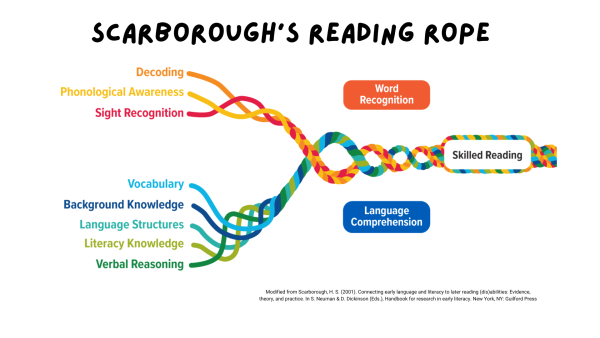
Imagine reading like braiding a rope.
Each strand in the rope is a different skill. When all the strands are woven together tightly, the rope gets stronger and so does your child’s reading!
The rope is made of two big skill groups:
Word Recognition
These are the skills that help kids read the words easily and automatically:
- Phonological Awareness: Playing with sounds in words (like rhyming or clapping out syllables).
- Decoding: Sounding out new words by matching letters to sounds.
- Sight Recognition: Instantly reading words they’ve seen many times (like “the” or “and”).
Language Comprehension
These are the skills that help kids understand what they read:
- Vocabulary: Knowing what words mean.
- Background Knowledge: Using what they know about the world to make sense of the story.
- Language Structure: Understanding grammar and sentence structure.
- Literacy Knowledge: Knowing how books work—like reading left to right or recognizing types of stories.
- Verbal Reasoning: Making guesses, connections, and understanding jokes or metaphors.
As these skills grow, your reader's "rope" gets stronger—and so does their reading confidence!