


100 Larkin Street
San Francisco, CA 94102
Estados Unidos
From the pages of special interest magazines like Skin Art, to the pages of academic journals like American Indian Quarterly, to the pages of popular magazines like Men’s Health, the representation and cultural significance of tattoos are on display in the collection of the Magazines and Newspapers Center. Each magazine’s purview directs the way its editors and journalists talk about tattoos to its readers—readers whose experiences with tattoos shape the content of the magazine, rendering each article unique to that magazine’s perspective. Yet, all examples tap into the shared themes of adorning and modifying the body to signal meaning to oneself and others, often heralding marks and scars as battle-won prizes of life experience and the bearer’s values. Drawing from bound volumes of magazines in the Center’s archives and the loose issues often on display in the Reading Room, this pop-up display both drills deeper into the theme of American Irezumi as well as demonstrates broader themes that unite tattoos across cultures.
This display connects to the exhibition Living Tattoo Traditions: American Irezumi and Beyond, on view in the Jewett Gallery Oct. 2, 2025–March 1, 2026.
Read the articles in the display
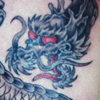 A1. Skin Art, vol. 8, no 68 (2000). "Flavor of the Orient," pages 40-44.
Flavor of the Orient was a regular column in early issues of Skin Art, illustrating the influence of irezumi motifs on Western tattoo aesthetics. SFPL owns Skin Art from roughly 1998 - 2023 minus a few missing issues. View the catalog record for Skin Art.
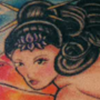 A2. Skin Art, vol. 7, no. 59 (1999). "Cover Girl Cathleen Capobianca," pages 44-45.
Cover girl Cathleen Capobianca shows off her beautiful backpiece ("senaka") that incorporates irezumi motifs of Japanese characters ("kanji"), a dragon, and the yin and yang symbol in support of the central subject ("shudai"), a buxom woman rising from a tumultuous sea in a flowing red shawl and skin-tight purple gown (perhaps a western-influenced Jigoku Dayu-type figure). Stormy and colorful wind-whipped waves function as both connective tissue ("keshoubori") and border ("botan-giri"), all in skillful gradation ("bokashi"), imbuing the piece with a feeling of kinetic energy and mayhem. SFPL owns Skin Art from roughly 1998 - 2023 minus a few missing issues. View the catalog record for Skin Art.
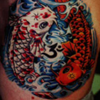 A3. Skin Art, vol. 9, no. 80 (2001). "The Joy of Koi," pages 27-33.
This issue includes a feature called Joy of Koi, celebrating the adoption of the irezumi motif of koi fish by many different tattoo enthusiasts. Japanese belief holds koi, also known as carp, as the bravest and most virile of all fish. SFPL owns Skin Art from roughly 1998 - 2023 minus a few missing issues. View the catalog record for Skin Art.
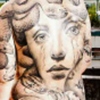 A4. Skin Art, issue 174 (2020). "Zhou Dan Ting," pages 4-9.
Tattoo shop owner and talented tattooist Ms. Zhou Dan Ting speaks about her shops in Shanghai, China and Folsom, California and showcases some of her handiwork. SFPL owns Skin Art from roughly 1998 - 2023 minus a few missing issues. View the catalog record for Skin Art.
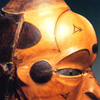 A5. Tribal, Summer 2004. "Emblems of the Body at the Dapper," pages 54-59.
This article explores, through artistic representation, the different marks, scars, piercings, and ornamentation that traditional societies use to communicate their civilized status to other individuals within their communities. It reproduces images of art pieces from an exhibit at the Musée Dapper in Paris, which closed in 2017, that demonstrate this. First called The World of Tribal Arts (1994-2002), then called Tribal: the Magazine of Tribal Arts (2002-2005), and finally called Tribal Art (2009-present), this magazine is an active subscription and SFPL owns a complete run of all issues from the very beginning. View the catalog record for Tribal.
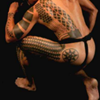 A6. Tribal Art, Summer 2012. "Tattoo Exhibit in Honolulu" and "Punu Mask Advertisement," pages 32-22.
An exhibit in Honolulu, Hawaii about native and contemporary tattoos is highlighted in the news section of Tribal Art magazine. Opposite, an ad featuring a Mukudj, a Punu female ancestor mask, from a gallery in Belgium displays a different type of beautification mark: diamond scars that indicate a woman's beauty for enduring such pain. First called The World of Tribal Arts (1994-2002), then called Tribal: the Magazine of Tribal Arts (2002-2005), and finally called Tribal Art (2009-present), this magazine is an active subscription and SFPL owns a complete run of all issues from the very beginning. View the catalog record for Tribal Art.
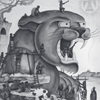 B1. American Indian Quarterly, Fall 2023. "A Sun that Never Sets: Eastern Cherokee Tattoo Artist John Henry Gloyne and the Aesthetics of Reimagining," pages 324-351.
By Honma, Todd and Francoso, Anthony. This article examines a selection of work by contemporary tattoo artist John Henry Gloyne (Eastern Band of Cherokee Indians) to understand how tattooing functions as an Indigenous creative practice that can imagine alternative realities and reestablish connections to Native pasts and presents. Gloyne's work redefines contemporary Native tattooing by highlighting its continuing significance and artistic innovations in the present. In doing so, Gloyne's work challenges the settler notion that Native cultural practices are static and stuck in the past.
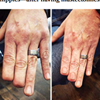 B2. Readers' Digest, September 2020. "Miracle Tattoos," pages 10-12.
Tattoo artist Eric Catalano shares examples of the paramedical and reconstructive tattoos he performs pro bono on Wednesdays at his tattoo shop in Hecker, Illinois.
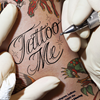 B3. Men's Health, November 2021. "Tattoo Me," pages 74-79.
The "tattoo extravaganza" in this issue of Men's Health includes advice about picking a tattoo design, identifying a good shop, and taking care of your tat, as well as stories from men about their tattoo choices and other amusing tidbits about contemporary tattoo culture. Don't forget to also check our "Ink-Redible" on page 7 of the issue.
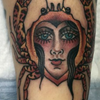 B4. Climbing, December 2018/January 2019. "Skin in the Game," pages 28-29.
Climber and tattoo artist Marina Inoue shares her experience learning the craft of tattooing in New York City and subsequently getting hooked on pursuing the mastery of new climbing spots in the great outdoors, which she funds by vending her tattoo services on the road.
 B5. Rolling Stone, August 2018. "Face-Tat Fever," pages 18-19.
This double-page spread of photographs showcases the face tattoos of eleven recording artists: Lil Skies, Rick Ross, Wiz Khalifa, Kehlani, Post Malone, Gucci Mane, Lil Xan, 21 Savage, Lil Wayne, Lil Pump, and Lil Uzi Vert.
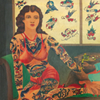 B6. Magazine Antiques, Jan/Feb 2017. "Gotham Ink: A New Exhibition Examines the Long, Colorful History of Tattooing in New York," pages 154-159.
Did you know tattooing was wholly underground in New York City from 1961-1997 due to a public health ban? This, along with other captivating facts highlighting the social history of tattooing in the City, fleshes out a 2,500-word narrative studded with pictures of artifacts from the exhibit.
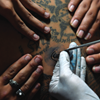 B7. Tricycle: The Buddhist Review, Spring 2022. "The Fine Print on Thai Tattoos," pages 17-19.
Tourists seeking sak yant (traditional Thai Buddhist tattoos) may not realize the stick-and-poke permanent markings can come with karmic strings attached.
C1. The Postal Record, July 2024. "The Forever Stamp," pages 31-33.

The monthly journal of the National Association of Letter Carriers explores the popular trend of getting a postage stamp as a tattoo, profiling the tattoos of celebrities and every-day people alike.
Art, Architecture & Photography
Learn from world-class designers, artists and experts in their fields.