

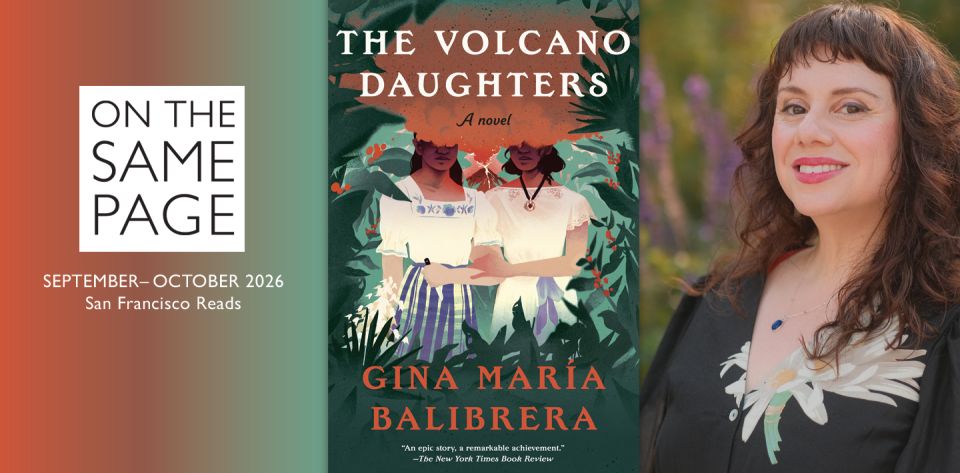
Sep-Oct 2026 On the Same Page Selection
The Volcano Daughters by Gina María Balibrera is a lyrical, politically charged novel set against the backdrop of 20th-century El Salvador, where a brutal dictatorship shapes the lives of those who resist it. At its heart is the story of two girls whose bond is forged in the shadow of violence, disappearance and state repression, their lives rippling outward through generations. Blending myth, memory and historical fiction, Balibrera explores the enduring impacts of trauma, the resilience of women’s voices and the power of storytelling to reclaim silenced histories.
Gina María Balibrera is the author of the novel The Volcano Daughters, which was a finalist for the Brooklyn Public Library Book Prize and awarded the Silver Nautilus. Originally from San Francisco, she lives in Ann Arbor, MI, with her family.
Gina María Balibrera will be in conversation with Ash Huang at the Main Library on October 4, 2026, 2 p.m.
Ash Huang is the author of The Secret Lives of Immortals, forthcoming in 2027 from Orbit and Redhook. She has been published in Lady Churchill's Rosebud Wristlet, Nightmare, Lightspeed, Ecotone, Orion’s Belt, and elsewhere. A winner of the Diverse Worlds Grant from the Speculative Literature Foundation, she is a grateful alum of the Roots. Wounds. Words. Workshop, Tin House Winter Workshop, and the Periplus Fellowship. She was a Reading Fellow for Tin House Workshop and a Brown Handler Resident with Friends of the San Francisco Public Library. She is currently a Fiction Editor at Orion’s Belt.
This program is sponsored by Friends of the San Francisco Public Library.
The novel blends historical events with folklore and magical realism. How did these elements work together for you? Did the magical elements deepen your understanding of the story or create distance from it?
The title centers daughters rather than heroes, leaders or historical figures. Why do you think Balibrera chose this perspective? What does the novel suggest about the role of women in shaping history?
Much of the book explores stories that have been forgotten, suppressed or erased. Why is remembering important in the novel? Who gets to decide which stories become history?
How do the women in the novel resist oppression, both in large and small ways? Which acts of resistance stood out to you most?
The novel spans generations. How are the experiences of one generation passed on to the next? What legacies—positive or negative—do the characters inherit?
The volcano serves as both a literal and symbolic presence throughout the book. What do you think the volcano represents?
Several characters must navigate the tension between personal desires and larger political realities. How do they balance survival, family and activism?
How does the novel portray the relationship between individual lives and national history? Did it change the way you think about historical events?
What responsibilities do authors have when transforming real history into fiction? How does Balibrera balance historical truth with imagination?
The book is rooted in the history of El Salvador, but many of its themes are universal. Which themes felt most relevant to contemporary issues or your own experiences?
What role does storytelling play in the novel? How do stories preserve memory, identity and culture?
Were there particular scenes, images or passages that stayed with you after finishing the book? Why do you think they were so memorable?
The novel explores both trauma and resilience. Did you come away feeling hopeful, pessimistic or something more complicated? Why?
If you could ask Gina María Balibrera one question about the novel, what would it be?
"Women and their power to save their own lives—and the lives of others—form the foundation of this globe-trotting novel that upends readers' expectations of who has the power to tell a story. Riveting, surprising and a bit spooky...A great book." —San Francisco Chronicle
Upcoming Events


